

When antidepressants fail to provide relief after multiple attempts, the experience can feel deeply isolating. You may find yourself wondering whether something is fundamentally different about your depression, or whether the right treatment simply hasn’t been discovered yet. At our clinic, we understand this frustration intimately. We work with many individuals who have tried two, three, or even more medications and various first-line treatment interventions, without achieving the lasting improvement they were promised. The reality is that Depression is not a condition with a universal solution. It manifests differently across individuals, with distinct underlying brain patterns that can help explain why standard approaches may work for some people but not others. This is precisely where neurofeedback becomes a valuable tool, offering objective insight into your brain’s electrical activity and guiding more personalized treatment decisions.
This article is for you if:
- You have tried multiple antidepressants and experienced only partial improvement or no improvement at all
- You are frustrated by the trial-and-error approach to medication
- You want to understand why standard treatments haven’t worked for you
- You are seeking evidence-based alternatives or complimentary treatment options to medication
- You live in the Ottawa region and are looking for specialized assessment services
This article is not for you if:
- You are newly diagnosed with depression and haven’t yet tried any treatment
- You are looking for general information about depression symptoms
- You are seeking emergency mental health support (please contact a crisis line or emergency services)
Understanding Treatment-Resistant Depression
Treatment-resistant depression (TRD) is a clinical term describing depression that does not respond adequately to standard antidepressant treatments. In clinical practice, this typically means that someone has tried at least two different antidepressant medications at therapeutic doses for sufficient durations, usually six to eight weeks each, without achieving remission or meaningful symptom reduction.
According to research on treatment-resistant depression, approximately 30% of individuals with major depressive disorder do not respond adequately to first-line pharmacological treatments. When more stringent definitions emphasizing complete remission are applied, some estimates suggest that more than half of people with depression may meet criteria for treatment resistance at some point in their illness course.
It is important to recognize that treatment resistance is not a personal failing. It reflects the neurobiological complexity of depression and the limitations of current approaches that treat all depression as essentially the same condition. Your brain is unique, and understanding its specific patterns is the first step toward finding what actually works for you.
The Spectrum of Treatment Response
Treatment response exists on a spectrum rather than as a simple yes-or-no outcome:
- Full response or remission: Symptoms resolve substantially, and daily functioning returns to baseline
- Partial response: Some improvement occurs, but significant symptoms persist
- Non-response: Little to no improvement despite adequate treatment trials
- Treatment intolerance: Side effects prevent adequate dosing or continuation of medications
Understanding where you fall on this spectrum helps clarify what type of re-evaluation and alternative approaches may be most beneficial.
Why Antidepressants Don’t Work for Everyone
Several factors contribute to treatment resistance:
Neurobiological heterogeneity: Depression is increasingly understood as an umbrella term covering multiple distinct conditions with different underlying brain mechanisms. What we call “depression” may involve overactivity in certain brain networks, underactivity in others, connectivity problems between regions, or combinations of these patterns. A single medication approach cannot address all these variations.
Genetic variations: Individual differences in genes affecting medication metabolism influence how quickly drugs are processed in the body, how they cross the blood-brain barrier, and how neurotransmitter systems respond. Two people taking the same medication at the same dose may have vastly different levels of active drug reaching their brains.
Complicating factors: Chronic stress, inflammation, sleep disturbances, and other medical conditions can maintain depressive symptoms independently of neurotransmitter function, rendering antidepressants less effective.
The limitations of trial-and-error prescribing: Standard practice involves trying one medication, waiting weeks to assess response, then switching or adding another if needed. This approach, while reasonable, does not account for individual brain differences that might indicate which treatments are most likely to succeed from the outset.
Is It Really Depression? The Critical Role of Accurate Diagnosis
Before assuming that your depression is treatment-resistant, it is essential to confirm that depression is indeed the primary diagnosis. Misdiagnosis is a common reason for apparent treatment failure, and several conditions can mimic or complicate depression:
Bipolar disorder: When bipolar disorder is misdiagnosed as unipolar depression, antidepressants alone may be ineffective or even destabilizing. Approximately 20% of people initially diagnosed with depression later receive a bipolar diagnosis, according to the clinical definition of major depressive disorder and related diagnostic considerations.
ADHD with mood dysregulation: Attention difficulties often co-occur with depression and can drive persistent low mood, frustration, and underachievement. Addressing ADHD directly may be necessary for full depression recovery.
Trauma-related conditions: Post-traumatic stress and complex trauma can present with depressive features but require trauma-informed treatment approaches beyond standard antidepressants.
Medical conditions: Thyroid dysfunction, sleep apnea, vitamin deficiencies, autoimmune disorders, and chronic pain conditions can all produce or worsen depressive symptoms.
Medication and substance effects: Certain medications and substances can cause or maintain depressive symptoms, complicating the clinical picture.
Comprehensive re-evaluation, including detailed history taking, psychological assessment, and potentially qEEG brain mapping, can clarify whether the original diagnosis was accurate and whether other factors require attention.
How qEEG Brain Mapping Works for Depression Assessment
Quantitative electroencephalography, or qEEG, measures the electrical activity generated by your brain and provides objective data about brain function that cannot be obtained through symptom questionnaires or clinical interviews alone. This assessment has been used clinically for decades and represents one approach to understanding individual brain differences.
What qEEG Brain Mapping Can Reveal About Your Depression
Research has identified several brain wave (EEG) patterns commonly associated with depression, though it is important to note that qEEG findings are probabilistic rather than deterministic. Thus, the qEEG cannot be used as a diagnostic tool, but can provide insight into how the brain is functioning and how this can contribute to presenting symptoms, and can help disentangle what may be truly underlying depressive presentations. Some examples of these biomarkers can be found below.
Frontal alpha asymmetry: One of the most studied markers involves the relative balance of alpha activity between the left and right frontal regions. Increased alpha power over the left frontal cortex relative to the right has been associated with reduced approach motivation and increased withdrawal tendencies, core features of many depressive presentations. This pattern may respond to interventions that specifically target left frontal activation.
Excessive frontal theta: Elevated slow-wave activity in frontal regions may indicate attention and concentration difficulties that complicate depression. When ADHD-related patterns are present, addressing attention directly may improve overall outcomes.
Beta abnormalities: Elevated high beta activity, particularly in frontal regions, can indicate an anxiety component that is perpetuating depressive symptoms. This finding might suggest that anxiety-focused interventions are needed alongside depression treatment.
Connectivity patterns: qEEG can also examine how well different brain regions communicate with each other. Disrupted connectivity between frontal control regions and emotional processing areas may help explain why someone struggles with emotion regulation despite medication.
From Patterns to Treatment Implications
The value of qEEG brain mapping lies not in the findings themselves but in how they inform treatment decisions. Rather than selecting treatments based solely on symptoms, which can appear similar across very different brain states, qEEG provides additional information to guide highly individualized treatment planning:
- Findings can guide the design of personalized neurofeedback training protocols
- Results may reveal patterns associated with conditions that require separate treatment interventions
- Brain mapping may help explain why previous treatments were not effective
Treatment Options Beyond Antidepressants
When antidepressants have not provided adequate relief, expanding the treatment approach becomes essential. Multiple evidence-based options exist, and the best choice often depends on individual factors including qEEG findings, personal preferences, and life circumstances. Often, integrative approaches combining multiple treatment interventions offer the most holistic and comprehensive benefits.
Neurofeedback
Neurofeedback uses real-time displays of brain activity to teach self-regulation of brain function. During neurofeedback sessions, sensors monitor your brain waves while you watch visual or auditory feedback that responds to your brain activity. When your brain produces more optimal patterns, you receive positive feedback; over time, your brain learns to maintain these healthier patterns more consistently.
For treatment-resistant depression, neurofeedback protocols are designed based on qEEG findings. If your brain map reveals left frontal underactivation, for example, training may specifically target increased activation in that region. This individualized approach stands in contrast to one-size-fits-all treatments.
Research published in peer-reviewed journals has demonstrated that EEG-based neurofeedback can reduce depressive symptoms and improve emotion regulation, with a pilot study showing 58% response and 50% remission rates when neurofeedback was added to medication in treatment-resistant cases.
Cognitive Behavioural Therapy
Cognitive behavioral therapy remains one of the most evidence-based psychological treatments for depression. CBT addresses the thought patterns and behaviours that maintain depressive symptoms, teaching practical skills for challenging negative thinking and increasing engagement with rewarding activities.
For treatment-resistant depression, intensive or specialized CBT approaches may be more effective than standard protocols. When a qEEG reveals patterns associated with attention difficulties or anxiety components, therapy can be adapted to address these specific challenges.
HRV Training and Biofeedback
Heart rate variability (HRV) training teaches individuals to gain voluntary control over the autonomic nervous system, which regulates stress responses. Many people with depression show reduced HRV, reflecting a nervous system stuck in stress mode. By training the body to achieve greater physiological flexibility, HRV training can support overall emotional regulation and resilience.
Combination Approaches
For complex, treatment-resistant depression, combining multiple modalities often produces better outcomes than any single approach. A comprehensive plan might include:
- Ongoing medication management
- Regular neurofeedback sessions targeting specific brain patterns
- Weekly psychotherapy to address thought patterns and life circumstances
- HRV training to support physiological regulation
- Lifestyle modifications including sleep hygiene, exercise, and nutrition
Neurofeedback as an Evidence-Based Option
Given the prominence of neurofeedback in brain-based treatment approaches, it deserves closer examination. Neurofeedback has been studied for depression for decades, and systematic reviews have found consistent evidence of symptom reduction across multiple trials.
What Neurofeedback Sessions Involve
A typical neurofeedback session lasts 30 or 60 minutes. After sensors are placed on your scalp, you watch a screen or listen to audio that responds to your brain activity. The experience is often compared to playing a video game where your brain is the controller. When your brain produces the targeted patterns, the feedback is positive; when it drifts toward less optimal patterns, the feedback changes accordingly.
Sessions are generally comfortable and even relaxing. Some people notice subtle shifts after the first few sessions, while more substantial changes typically emerge over 12 to 24 or more sessions. Progress is monitored through repeat symptom assessments and, in some cases, follow-up qEEG recordings to confirm changes in brain activity.
Addressing Legitimacy Concerns
Some people wonder whether qEEG brain mapping and neurofeedback are legitimate clinical tools. This is a reasonable question given the marketing claims made by some providers. The evidence supports the following conclusions:
- qEEG is a well-established neurophysiological measurement technique used in research and clinical settings worldwide
- Professional organizations, including the International Society for Neuroregulation & Research (ISNR), have published standards for clinical qEEG use
- Peer-reviewed research supports neurofeedback efficacy for several conditions, though more large-scale trials are needed
At the same time, qEEG is not a diagnostic test in the same way a blood test diagnoses diabetes. It provides additional information to guide clinical decision-making rather than definitive answers. Responsible providers present qEEG findings in context, acknowledging both their value and their limitations.
A thorough evaluation for treatment-resistant depression may include:
- Detailed clinical history: Reviewing all previous treatments, their durations, doses, and effects
- Comprehensive symptom assessment: Using validated measures to characterize current symptoms precisely
- Differential diagnosis consideration: Ruling out or identifying co-occurring conditions
- qEEG brain mapping: Obtaining objective data about brain function patterns
- Psychological assessment: Evaluating cognitive, emotional, and personality factors that may be relevant
Treatment Planning
Based on assessment findings, a personalized treatment plan is developed. This plan specifies:
- Primary interventions and their sequencing
- Secondary or supportive interventions
- Session frequency and expected duration
- How progress will be measured
- When and how the plan will be adjusted if needed
Realistic Expectations
Improvement in treatment-resistant depression is often gradual rather than intense or immediate. Setting realistic expectations is important:
- Initial changes may be subtle, such as improved sleep or slightly more energy
- Full response often requires consistent engagement over months, not weeks
- Treatment plans may need adjustment as more is learned about what helps
- The goal is meaningful improvement in symptoms and functioning, though complete remission may not always be achieved
Taking the Next Step: What to Expect from qEEG Assessment
If you are considering qEEG brain mapping as part of your evaluation for treatment-resistant depression, here is what to expect at our clinic:
Before Your Appointment
We will ask you to:
- Wash your hair the morning of your appointment without using conditioner or styling products
- Get adequate sleep the night before, as sleep deprivation affects brain wave patterns
- Continue your regular medications unless specifically instructed otherwise
- Avoid excessive caffeine on the day of testing
During the Assessment
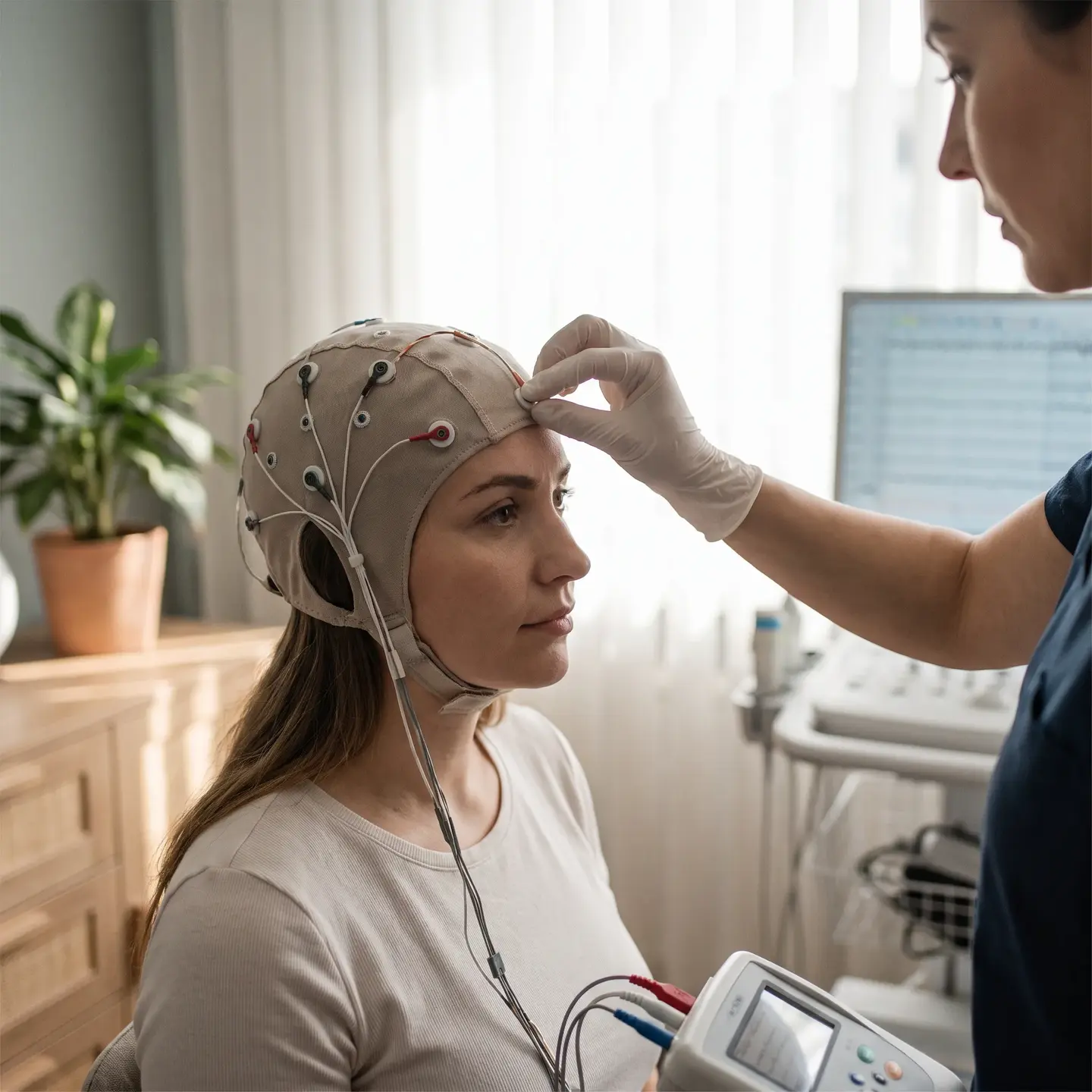
The qEEG recording itself typically takes 20 to 30 minutes. A technician will place the sensor cap on your head and ensure good contact at each electrode site. You will be asked to sit quietly with your eyes closed, then with your eyes open, while the recording is completed. Most people find the experience comfortable and uneventful.
After the Assessment
The recorded data are processed and analyzed, comparing your brain activity to normative databases. A clinician will then review the findings with you, explaining what patterns were identified and what they may mean for your treatment. This interpretation session is crucial, as it connects technical findings to practical next steps.
Cost and Practical Considerations
qEEG brain mapping is not covered by Ontario Health Insurance Plan (OHIP) and is typically paid out of pocket. Some extended health insurance plans may provide partial coverage depending on your policy. We encourage you to check with your insurance provider about coverage for psychological assessment services.
Moving Forward with Hope and Science
Living with treatment-resistant depression is exhausting, and the repeated disappointment of treatments that don’t work can erode hope. We want to offer a different perspective: treatment resistance is not a dead end but rather a signal that a more individualized approach is needed.
qEEG brain mapping represents one tool in our comprehensive depression treatment approaches, providing objective information that can explain why standard treatments haven’t worked and guide more targeted interventions. When combined with evidence-based therapies and careful clinical judgment, this technology supports the kind of personalized care that complex depression requires.
If you have been struggling with depression despite multiple treatment attempts, we invite you to reach out. Our team includes registered psychotherapists, psychologists, and neurofeedback technicians experienced in working with treatment-resistant presentations. We offer qEEG brain mapping at our Nepean and Stittsville locations, with neurofeedback for depression available at all three of our Ottawa-area sites.
No referral is required to begin the conversation. You can contact us to schedule a consultation and discuss whether qEEG-guided assessment and treatment might be a helpful next step in your journey toward feeling well again.

Frequently Asked Questions
You’ll wear a cap with sensors for about 20 to 30 minutes while sitting quietly with eyes open and closed. It’s non-invasive, comfortable, and simply records existing brain activity without sending anything into your brain.
Yes, qEEG can highlight specific brain activity patterns such as frontal alpha asymmetry, excessive frontal theta, or high beta linked to anxiety that may clarify why past medications were less effective and point toward more tailored options.
In Ontario, qEEG is not covered by OHIP and is usually paid out of pocket, though some extended health plans may reimburse part of the cost. It’s worth checking your policy for psychological assessment coverage.
If you’ve tried at least two different antidepressants at appropriate doses for six to eight weeks each and still have significant symptoms, you likely fit the definition of treatment-resistant depression and this article is designed for you.
No, qEEG is not a stand-alone diagnostic test. It adds objective brain data to a thorough clinical and psychological assessment so your provider can refine your diagnosis and treatment plan, rather than replace standard evaluation.